Testing and analysis
Backtesting vs Forward Testing: Differences and Next Steps
Published Updated ForeXpert team日本語で読む
Backtesting vs forward testing is a distinction about data and timing. Backtesting applies trading rules to historical prices. Forward testing checks rules on new market data arriving after the rules have been fixed. In this article, forward testing means observing live-time prices in a demo or paper-trading setting, without using real money.
Historical replay lets you repeat decisions quickly. Real-time testing helps you examine waiting, scheduling and execution as new opportunities appear. This guide compares the two and explains how to move between them without silently changing what you are testing.
Backtesting vs forward testing: the differences
Both methods investigate how a rule behaves, but the information and passage of time differ. A strong historical result cannot simply be carried over as the expected result on a new market period.
| Aspect | Backtesting | Demo forward testing |
|---|---|---|
| Data | Historical prices already available | Prices arriving after the rule is fixed |
| Time | Can be replayed and advanced quickly | Requires waiting in real time |
| Main questions | Rule clarity, historical results and weaknesses | Execution, record keeping and patience |
| Limitations | Hindsight, overfitting and missing costs | Few opportunities and different fill assumptions |
| Real capital | Not required | Not required on demo |
Some people also use forward testing to mean testing an unseen historical period. That overlaps with out-of-sample testing. To avoid confusion, label your record as either unused historical data or new live-time data. The label should describe what information was actually available when the rule was created.
What each method can and cannot show
What backtesting can reveal
Applying the same rule to several past periods can expose vague entry or exit conditions. You can review win rate, average outcome, profit factor and maximum drawdown, while recording where you hesitated. It is particularly useful for clarifying the decisions you intend to repeat.
However, knowing the outcome can influence judgment. Even if future candles are hidden, remembering the wider price path is a limitation worth recording. Fast replay also does not reproduce the experience of waiting through a quiet session or fitting trading around other obligations.
What forward testing can reveal
New prices were not known when the rules were written. Keeping those rules fixed lets you observe whether you can recognize setups at the relevant time, wait for them and place orders as intended. Missed opportunities become useful execution information.
Demo fills and costs may differ from a live account, and a demo does not reproduce the pressure of losing real money. The NFA discussion of hypothetical performance explains that hypothetical trading cannot fully account for the effects of actual financial risk. A demo result should therefore be labeled as a demo result.
Keep historical validation distinct
Holding back an unused part of history is useful, but repeatedly looking at it and changing rules means it is no longer unseen. Our overfitting guide explains how to preserve development and validation roles. A period's role depends on how it was used, not just its name in a spreadsheet.
Four steps from backtesting to forward testing
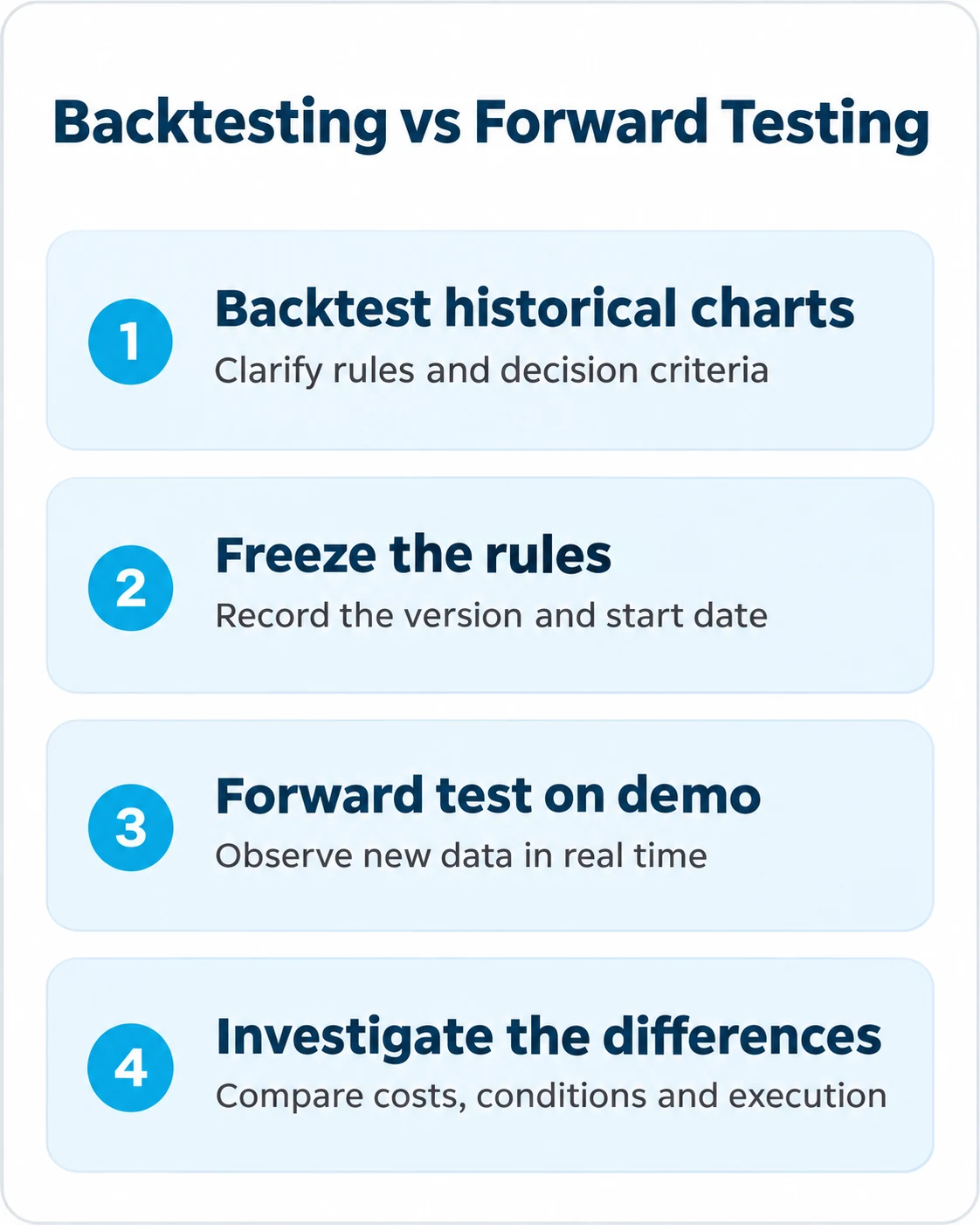
1. Make the rules explicit on historical charts
Write entry, stop, exit and exclusion conditions clearly. Replace phrases such as “when the trend looks good” with the observations used to make that judgment. Our five-step backtesting guide covers the practical process.
Decide using only the chart available at that moment and record whether each trade followed the rule. A good historical score is difficult to evaluate if you cannot reproduce the underlying decisions. Clarifying those decisions is a useful result even before you interpret the statistics.
2. Freeze the rules and review schedule
Before forward testing, record a version number, start date, pair, timeframe and sessions you will observe. Set a review date and state how you will handle too few trades. This keeps the evaluation from ending only when a favorable result appears.
If opportunities are scarce, do not loosen entry conditions just to reach a quota. Record that the evidence is limited, and document any extension to the test period. A different rule should begin as a new version rather than being silently added to the existing record.
3. Record real-time demo decisions
Log the qualifying setup, reasoning, intended order, actual simulated fill, exit and net result. If you miss an opportunity because you were unavailable, record it as missed rather than inventing a fill afterward. Keep opportunity counts separate from executed demo trades.
On days without a setup, do not create a trade merely to keep the log active. Waiting is one of the behaviors that fast historical replay cannot fully examine. A record of no qualifying setup can still explain how the test was conducted.
4. Investigate differences before changing rules
If forward results differ from backtesting, examine conditions, sample size, costs, sizing and adherence before deciding the strategy itself changed. A difference in headline profit does not identify its cause.
Pasting both lists of results into our backtest results calculator puts win rate, average result and maximum drawdown side by side under the same definitions, which makes the gap easier to locate.
| Difference | What to check first | Useful record |
|---|---|---|
| Fewer entries | Market conditions and missed opportunities | Qualifying opportunities vs executed trades |
| Larger losses | Stop changes, fills and size | Planned vs actual exit |
| Earlier profit-taking | Anxiety or ambiguous exit conditions | Whether the written rule was followed |
| Different costs | Included fees and observation times | Consistent net-profit calculation |
If you change the rule, close the current version's evaluation and begin a new version. Combining both into one performance figure makes it unclear what the result describes. Preserve the original record even when you later understand why it disappointed.
Comparing results fairly
Equal calendar periods can contain different information
Two one-month tests need not contain similar opportunities. One may have persistent trends and the other extended sideways movement. Report setup counts and market context alongside dates, rather than assuming equal duration produces comparable samples.
A short forward test with losses may contain too little evidence to identify the cause. Conversely, a short winning run does not establish that the rules transferred successfully. Read the actual decisions and the distribution of outcomes before drawing a conclusion.
Do not present demo results as live performance
Label historical simulations and real-time demo tests explicitly. Neither is the same as a record from risking actual capital. Backtest results do not guarantee future performance, and demo outcomes do not remove that limitation.
Make the assumptions visible as well: which costs were included, how fills were recorded, whether position size changed and which sessions you could observe. These details help explain discrepancies that a single return figure cannot.
Match the tool to the purpose
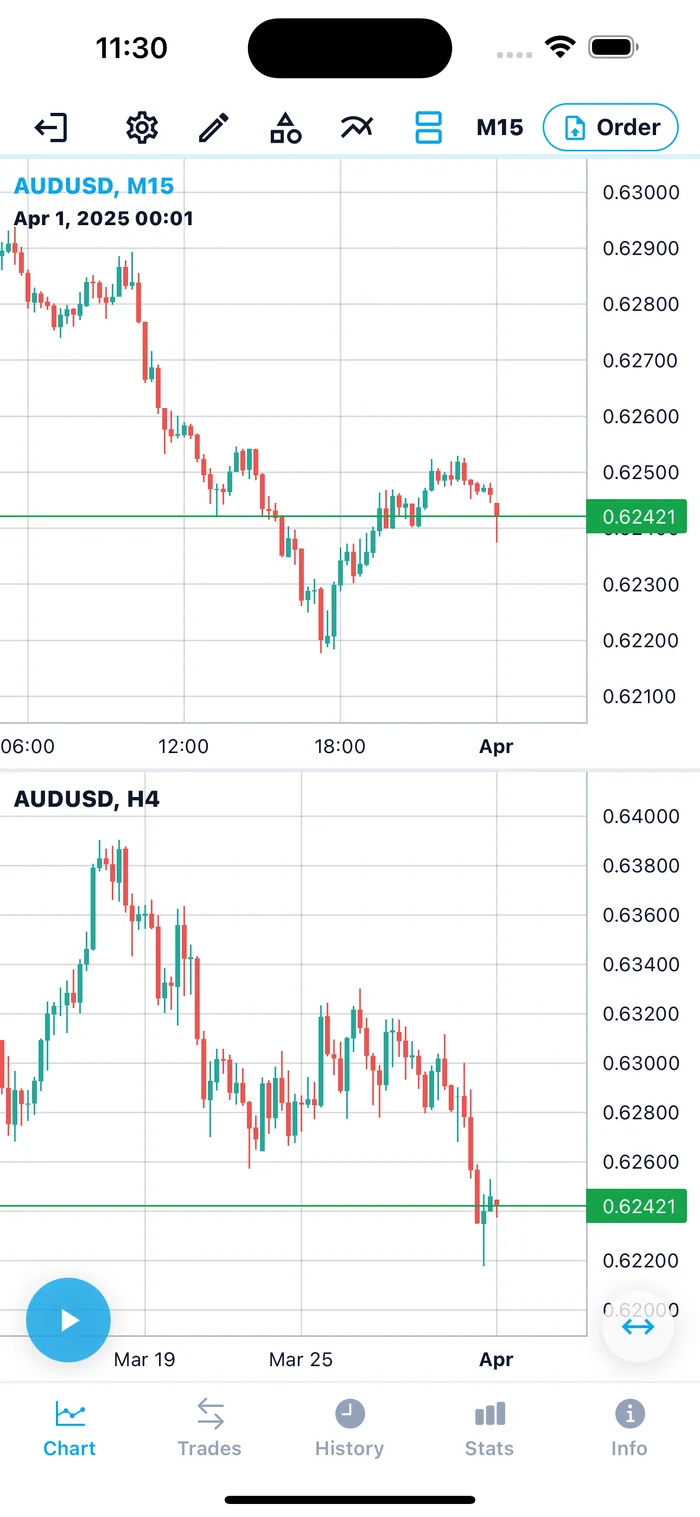
ForeXpert is an iOS app for repeating discretionary decisions on historical charts without real capital. It serves the historical practice stage described here, rather than acting as the live-time demo account used in this article's definition of forward testing.
You can use historical practice to refine the wording of a rule and inspect difficult examples. Keep the later real-time demo record separately so each stage answers its own question and neither result is mistaken for the other.
Frequently asked questions
Can I skip backtesting and only forward test?
You can observe new prices directly, but you must wait for opportunities. If the rules are still vague, that can make clarification slow. Historical examples help turn the idea into repeatable conditions before you use real-time data to examine execution.
How long should forward testing last?
There is no universal duration. Setup frequency and market conditions determine how much information a period contains. Report both time and count. Our backtest sample-size guide explains why a count alone is not enough to judge reliability.
Should I change rules as soon as results worsen?
At the planned review point, check adherence and measurement assumptions first. If you stop earlier for a risk-related reason, record the reason and date. When a revision is warranted, start a new version and preserve the previous result rather than rewriting it.
Summary
Backtesting organizes rules and decisions using historical data. Forward testing checks fixed rules on new live-time data, including whether you can wait and execute consistently. Investigate differences through the record rather than relying on one favorable score.
Start by writing the current rule version and deciding which data and review date come next. Clear labels and fixed conditions make the information from each stage easier to compare.