Testing and analysis
How to Backtest a Forex News Filter Around Releases
Published ForeXpert team日本語で読む

To backtest a forex news filter, run your usual rules and a version that pauses new orders around scheduled economic releases over the same historical period. Before you start, decide what happens to orders that are still pending and positions that are already open. Those decisions can change the comparison even if both runs use the same release calendar.
A useful test starts from the release schedule you could have known at the time. It ends with a record of which decisions changed. This example walks through both, using a fictional release time to show how a pause works on a 15-minute chart.
Pick releases and align the calendar with your chart
Choose a currency pair, a release series, and a period. For example, you could study the US Employment Situation for a pair that includes the US dollar. Include every qualifying release in the period, even the ones that were followed by quiet price action. The US Bureau of Labor Statistics release schedule is a starting point for locating those releases.
In a worksheet, record the release name, relevant currency, scheduled date and time, original time zone, equivalent chart time, and source. If you also look up when a delayed report actually came out, put that in a separate field. The decision to pause orders should use the schedule that was available at the decision time. If you can reconstruct when a postponement was announced, you can update the schedule from that point in the replay.
A calendar maintained today may reflect changes made after the original schedule was posted. Where you cannot verify what was known, mark the schedule as uncertain and record which dates or segments you omit from both runs. Guessing the release time from a price spike gives your rule information that only became available afterward. The same issue appears in other forms of look-ahead bias in backtests.
Use the release date and the named time zone together when converting. A release listed in US Eastern Time can map to a different chart hour depending on the date and the chart's time zone. Also check whether a candle is labeled with its opening time. Our guide to forex backtesting time zones covers how to line up these conventions.
Define what your forex news filter does
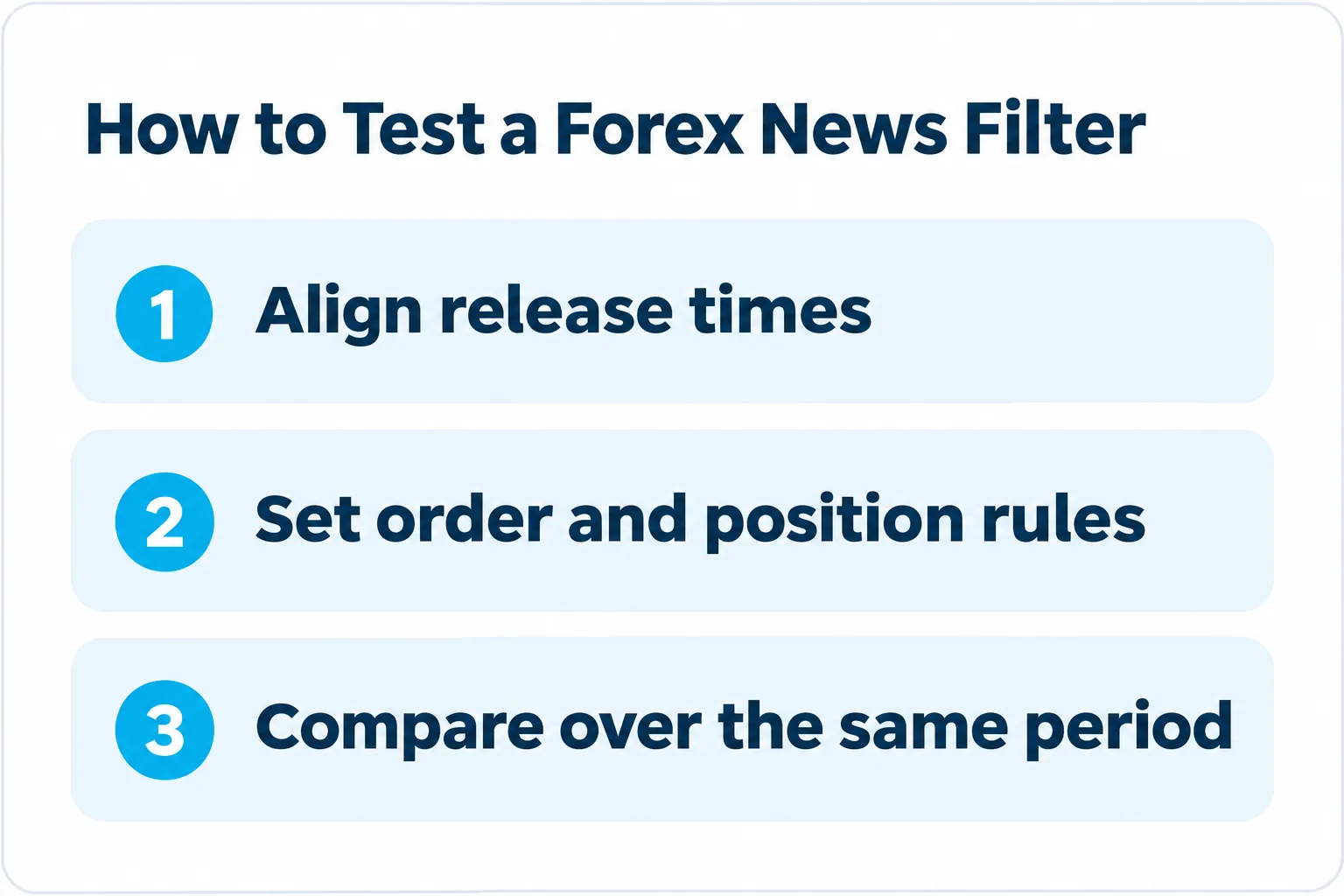
“Skip the news” leaves several decisions open. A limit order placed earlier could still fill during the pause. An open position could also hit its usual exit while new entries are suspended. Write down what the filter does in each case before stepping through the data.
| Decision | Example rule for the filtered run |
|---|---|
| New entry orders | Pause during the window and evaluate the entry conditions again when it ends |
| Pending entry orders | Cancel them when the pause begins and require a fresh decision before resubmitting |
| Open positions | Keep the ordinary exit rules active throughout the window |
That example tests an entry pause with cancellation of pending entries. A rule that closes positions before a release also changes when and how exits occur. Test that change in a separate comparison if you want to learn what the extra exit rule contributed.
Record exactly when the pause begins and ends. A test window of 15 minutes before to 15 minutes after a scheduled release could include the starting instant and allow normal decisions at the ending instant. If windows overlap, decide whether to combine them into a single pause. That detail matters when two qualifying announcements are close together and a signal arrives near the boundary.
Walk through a fictional release on a 15-minute chart
Suppose the release is scheduled for 14:30 in chart time. The pause starts at 14:15 and ends at 14:45. This example evaluates entry signals after each 15-minute candle closes and records the close time as the decision time. The release and window are illustrative.
| Decision time | Candle just completed | What the filtered run does |
|---|---|---|
| 14:15 | 14:00–14:15 | Start the pause, withhold new entry orders, and cancel pending entry orders |
| 14:30 | 14:15–14:30 | Keep the entry pause in effect and continue applying ordinary exits |
| 14:45 | 14:30–14:45 | Resume entry checks and evaluate the conditions at that moment |
On a chart labeled by candle opening time, the first row refers to the candle labeled 14:00. Its closing value is available at 14:15. Using the label as the time you knew the close would shift the decisions by a whole bar. Logging the actual decision time makes boundary cases easier to check.
The 14:45 decision in this example uses a candle that includes the period immediately after the release. If your rule requires a candle that began at or after the end of the pause, write down that condition as well. In this example, the first eligible candle would open at 14:45 and close at 15:00. These two versions use different information, so keep the rule consistent across releases.
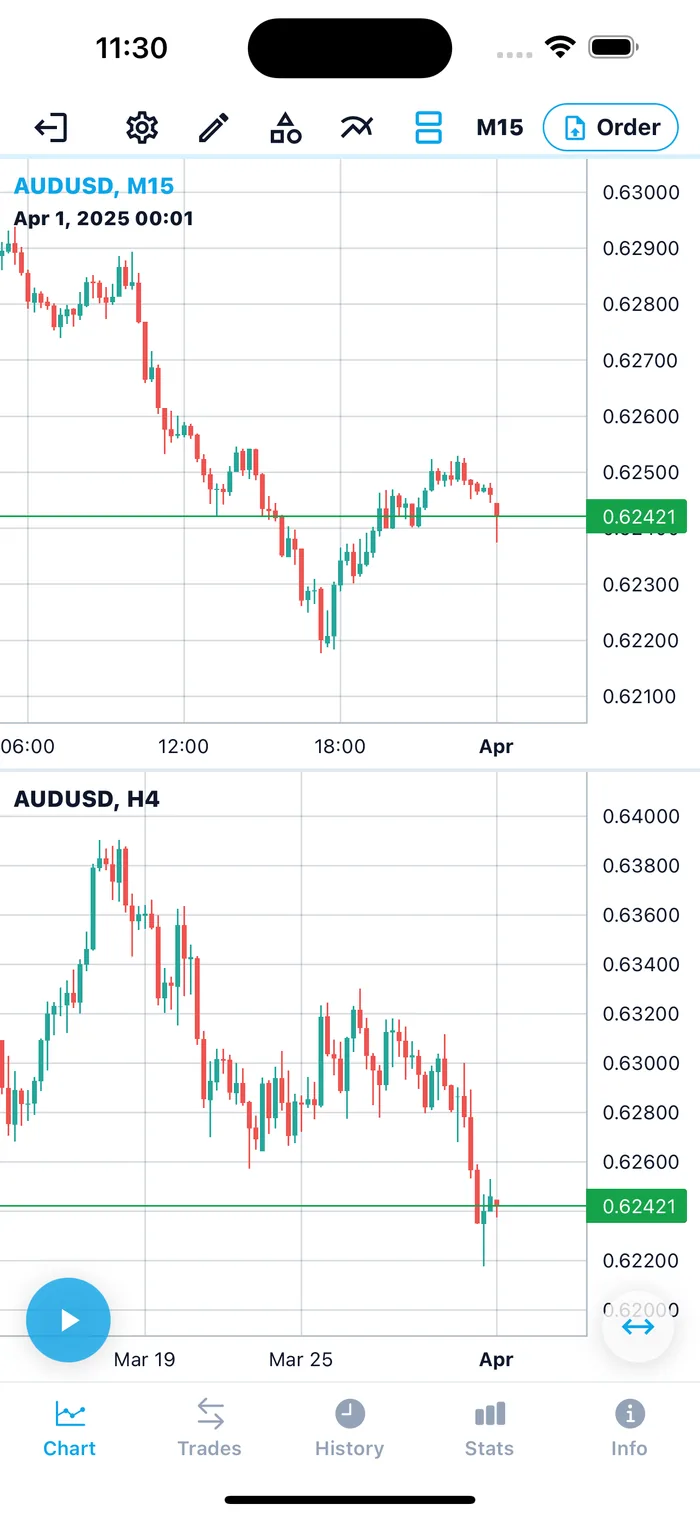
In ForeXpert, you can step through historical candles one at a time. Keep your release worksheet beside the chart and log whether you placed an order, canceled a pending entry, or already held a position at each relevant time. See the step-by-step forex backtesting guide for the full manual workflow.
Compare both runs over the same period
Use the same pair, timeframe, historical period, ordinary trading rules, and cost assumptions. Keep the release candles in the replay. Skipping them could change the indicators after the pause and could skip exits on positions held through the release.
Count the releases covered, entry orders withheld, pending entry orders canceled, and positions open when the reports came out. Replay each version in sequence. A skipped entry can free up capacity for a later signal under a one-position rule, and the later signal may occur at a different price. Record the new decision when it happens so you can trace the difference between the runs.
Review the order log alongside the totals. When the filter changes the number of trades, total profit or loss alone gives little detail about what happened. Find the releases and orders that account for the largest changes. If a single release dominates the comparison, record that and repeat the same rules on another period before drawing a broader conclusion.
Candles summarize the open, high, low, and close of each interval. The bid and ask at the moment of an order, and the price you would have received, require separate execution data. Document your cost assumptions and check separately how sensitive the comparison is to changing those assumptions. Our guide to forex backtesting costs explains which execution costs can affect the comparison. Historical tests cannot guarantee future results, and live trading carries a risk of loss.
FAQ
How long should the pause be?
Choose a test window that fits your timeframe and the question you want to answer. If you try several windows and select one after reviewing the results, keep a record of the versions you tried and check the selected rule on a period you did not use to choose it.
What if my data is too coarse for the release time?
Use data that supports the timing decisions you intend to test. Hourly bars alone cannot tell you the sequence of decisions a quarter of an hour apart inside a single bar. You can instead define a rule that acts only at hourly candle closes or flag cases you cannot evaluate from the available data.
Do I need the actual reading or the market forecast?
A schedule-based pause only needs the information that was available about when the release was due. A rule that uses the reported number or the market forecast needs separate data. For that kind of test, distinguish the initial release from later revisions and verify when the forecast was available.
Summary
Start with one release series and convert the historical schedule to chart time. Specify how the pause affects new orders, pending entries, and open positions, then replay the usual and filtered rules over the same period. Review the changed orders before interpreting the difference in overall results.