Journaling and review
A No-Trade Journal for Backtesting: Log Skipped Setups
Published ForeXpert team日本語で読む

When you skip a potential trade in a backtest, record the conditions and your reason before revealing the next candle. A later price move cannot tell you whether you followed your rules at the decision point. A valid skip and a missed qualifying setup both produce no order, but they call for different kinds of review.
A no-trade journal supplements your ordinary trade log. It captures selected situations in which you considered an order and did not place one. This guide explains how to define those situations, write a short record, classify the decision and review it without rewriting history. The categories below are our suggested practice framework, rather than a trading signal or an established performance measure.
Why keep a no-trade journal in backtesting?
An order history tells you which trades you placed. By itself, it does not explain the decisions that produced no order. A quiet session might mean that nothing met your conditions. It might also mean that you hesitated when a qualifying setup appeared, or could not interpret a vague rule.
Those are different problems. If the final entry condition was absent, following the rule meant waiting. If every required condition was present and no exclusion applied, failing to act deserves a different note. If a phrase such as “a clear pattern” could not be interpreted consistently, the rule needs clarification before the decision can be evaluated.
The aim is to preserve that distinction. Use our trading journal review guide for the trades you actually placed, and this supplementary log for candidate situations that ended without an order. Neither record should be edited simply because the next candles make a different decision look attractive.
Define a candidate before starting replay
You do not need to write “no trade” for every candle. Instead, decide in advance when a situation becomes worth recording. Otherwise, it is easy to collect only the dramatic moves that stand out after you have seen the outcome.
For a practice exercise, you might write: “Record a candidate whenever a completed decision candle meets the preparation conditions, even if the final entry condition fails.” Define the preparation and entry conditions in your own rule set. This example specifies a recording process; it does not recommend a particular setup or market direction.
Fix the pair, timeframe, observation period and decision timing too. Decide how repeated candidates will be counted. For example, you could treat several consecutive bars with the same conditions as one candidate, and open a new record only after the conditions disappear and return. The useful part is having a consistent definition, rather than choosing a universal counting rule.
If recording every candidate in a long period is too much work, choose a shorter observation window before beginning. Do not remove quiet days or inconvenient examples after reviewing the results. Our beginner’s backtesting guide explains how this scope fits into a complete manual test.
Build a no-trade journal in four steps
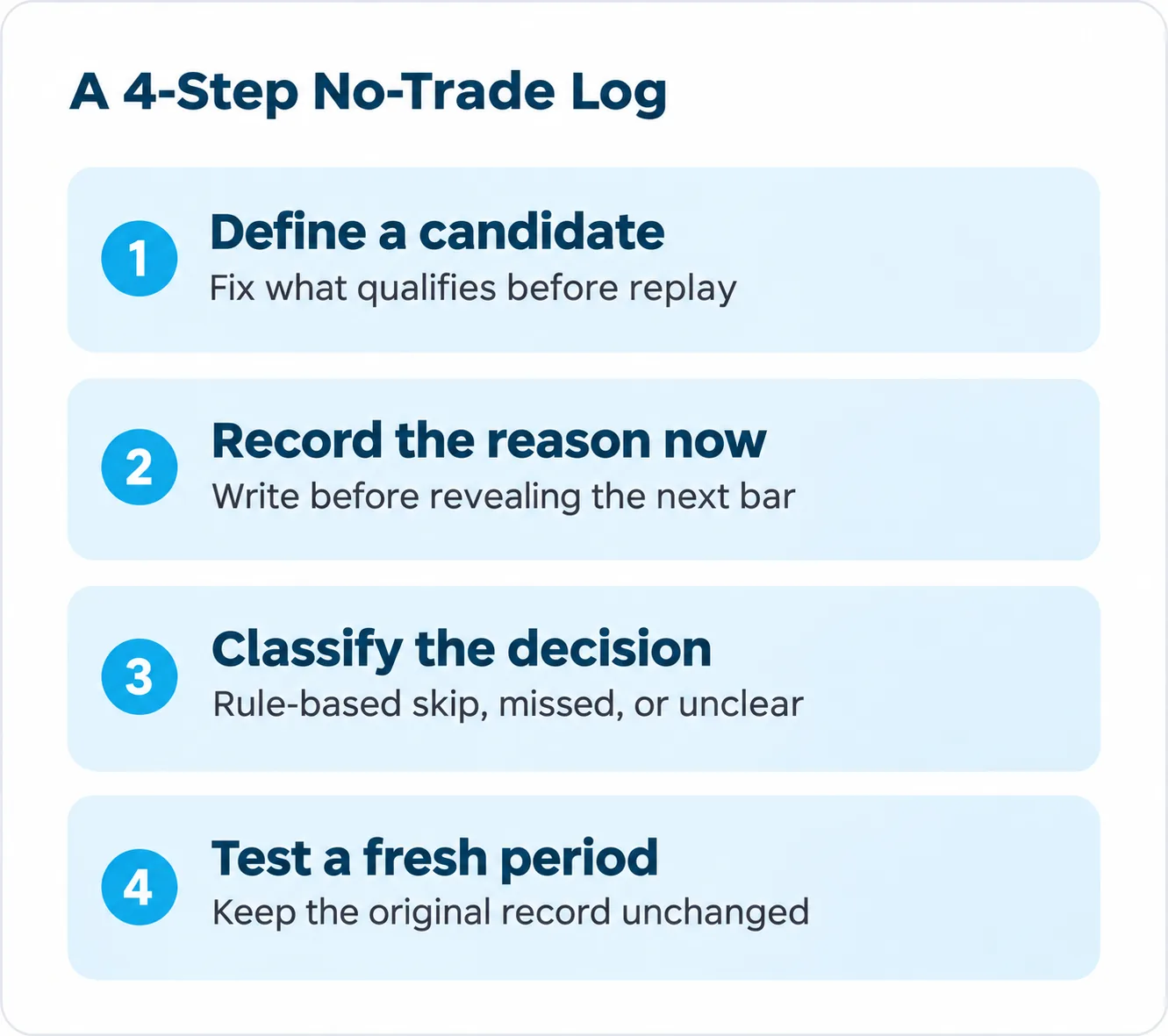
1. Stop at the candidate’s decision time
Advance through historical data until the prewritten candidate conditions are met. Stop before revealing the next bar. Note the chart timestamp and the last completed decision candle, rather than only the date on which you are doing the exercise.
Historical replay is a way to move through past market data sequentially; TradingView’s official Bar Replay explanation describes that approach (checked November 2026). For this exercise, the key is preserving what was visible at the decision point, whichever replay tool you use.
2. Separate observed conditions from your reason
“I felt nervous” is incomplete. A more useful entry is: “The final condition was met and no exclusion applied, but I delayed because I was thinking about the previous trade.” This records both the rule state and the reason for taking no action.
If you cannot evaluate a condition, write “unclear” instead of forcing it into a yes-or-no answer. Save any chart capture before exposing later candles. If you discover a candidate only after moving forward, label it as a retrospective discovery. Our guide to look-ahead bias explains why future information changes the meaning of a historical decision.
3. Classify the decision using information available then
Use the categories below as a small working vocabulary. The label depends on the written rules and available information, rather than on whether a hypothetical order would later have made money.
| Category | State at the decision point | What to review |
|---|---|---|
| Rule-based skip | A final condition failed, or a prewritten exclusion applied | Whether you applied that condition consistently |
| Missed qualifying setup | All required conditions were met, no exclusion applied, but no order was placed | Where hesitation or the execution process interrupted the decision |
| Unclear | The wording or available information did not support a decision | Which definition or information was missing |
4. Keep the original record through the review
Put later observations into a separate follow-up field. Do not replace the original reason with a better explanation after seeing the outcome. If a classification needs correction, retain the first label and explain the correction alongside it.
This also makes disagreement useful. On review, you may discover that two apparently similar candidates were treated differently. That is a reason to inspect the original wording and screenshots, rather than to settle the question by checking which candidate had the more favorable price move afterward.
A template and example without invented performance
Keep the first version small: candidate ID, chart time, pair and timeframe, rule version, condition status, classification and the reason written at the time. Add a screenshot reference and a separate follow-up field if needed. A notebook or spreadsheet is sufficient as long as the original entry remains readable.
The following entries are fictional examples of record wording. They do not describe real market events or measured test results. A, B and C stand for conditions that would have been defined before the test.
| Candidate | Original record | Classification | Follow-up question |
|---|---|---|---|
| N01 | A met, B not met; final condition absent, no order | Rule-based skip | Was every comparable failure of B excluded? |
| N02 | A and B met, exclusion C absent; hesitated and placed no order | Missed qualifying setup | Which part of the decision process stalled? |
| N03 | A met; could not interpret B’s “clear pattern” wording | Unclear | Can the ambiguous phrase be defined more precisely? |
If price later moves favorably after N01, the original skip does not automatically become a mistake. Likewise, an unfavorable later move after N02 does not turn hesitation into rule compliance. Evaluating the decision and evaluating a hypothetical outcome are separate tasks.
Do not add skipped candidates to the normal results as if orders had been placed. If you want to investigate what would have happened under a different rule, create a separate test with explicit entry and exit assumptions. Adding only attractive missed opportunities afterward makes the revised record unsuitable for comparison with the original test.
If you want to change how the test handles signals while a position is open, replay the same timeline under each cap. How to backtest overlapping forex trades walks through an example.
A retrospective discovery can still generate a research question. Keep its origin visible, state that the original reason is unknown, and test the question on fresh data. Avoid filling that missing reason from memory and treating it as a contemporaneous note.
Practice in ForeXpert and keep reasons in a separate note
ForeXpert lets you advance historical charts one bar at a time and practice order decisions. It also supports displaying multiple timeframes. At a candidate, stop advancing, write the chart timestamp and your reason in your own notes, then continue the exercise.
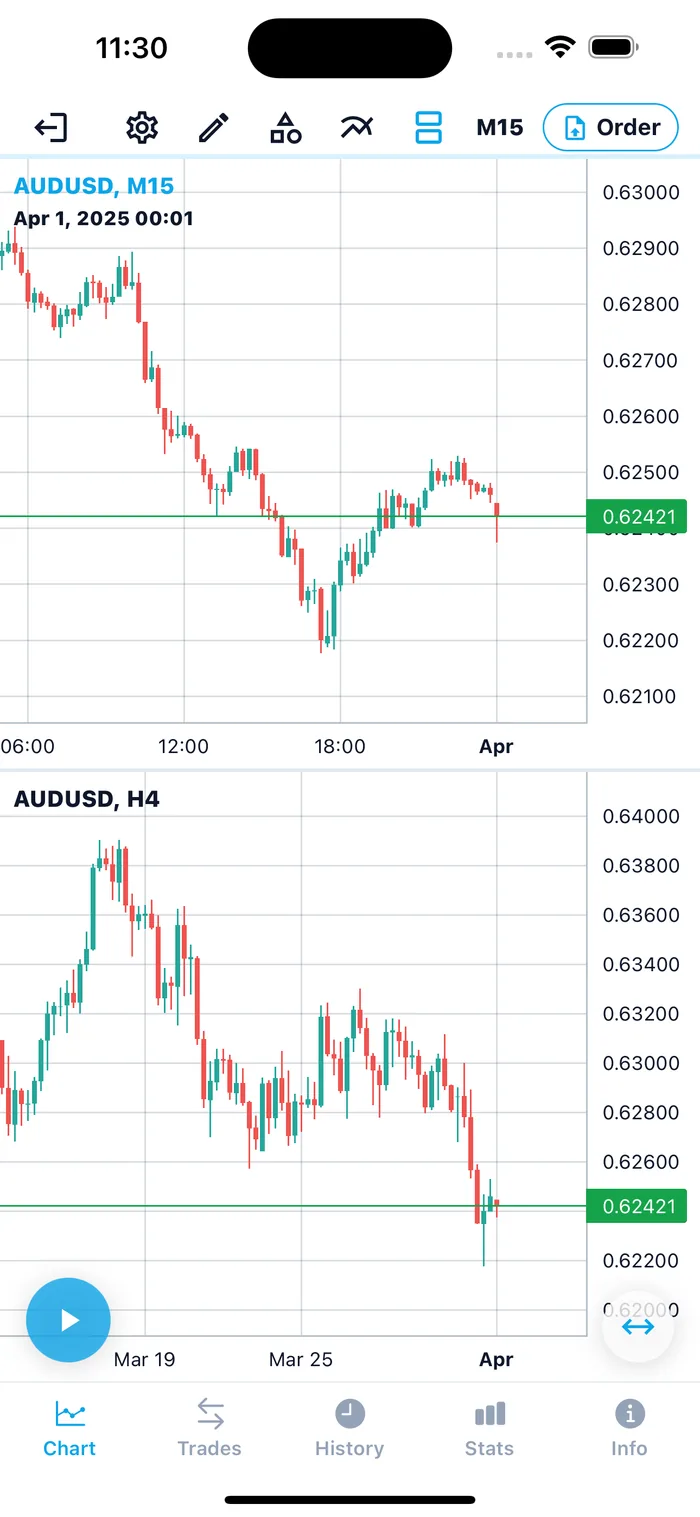
The screenshot illustrates chart practice; it does not show a field for entering no-trade reasons. Keep the classification table and follow-up notes in a separate notebook or spreadsheet. If you use several timeframes, define which chart supplies the decision and which provides supporting context before recording candidates.
At the scheduled review, read the unclear cases for repeated gaps in the rule wording. Then examine the reasons for missed qualifying setups. If a change is needed, preserve the old record and test the revised wording on a different period. Our rule change log guide explains how to keep versions and observations separate.
Historical backtest results do not guarantee future performance, and live trading involves a risk of loss. The purpose of this journal is to make decisions explainable and repeatable, rather than to turn every skipped move into a supposed missed profit.
FAQ
Should I record every candle without an order?
No. Record candidates defined before the test. If that creates too much work, shorten the next observation period in advance and keep all qualifying candidates within that window. Avoid selecting only the examples that later look interesting.
Can I include a missed setup found afterward?
Yes, if you label it as a retrospective discovery and leave the original decision reason unknown. Keep it separate from observations written before the next bar was revealed. It can suggest a new question, but it cannot supply evidence of what you thought at the time.
Does skipping more trades mean I am being disciplined?
The number alone cannot answer that. You may have followed exclusions consistently, encountered few qualifying setups, or struggled to interpret the rules. Read the categories and reasons before deciding what to practice next.
Summary
Define a candidate, record the reason before revealing future candles, and distinguish rule-based skips, missed qualifying setups and unclear decisions. Start with those three labels and one sentence per candidate in your next short replay session.
Keep later observations in a separate field. When a rule needs clarification, document the change and test a fresh period while preserving the original record.