Journaling and review
How to Review a Trading Journal: 4 Ways to Improve
Published Updated ForeXpert team日本語で読む

A trading journal does not improve your trading just because you fill it in. Organize the records, compare similar situations, and choose one change to test next to turn your trades into useful practice.
This guide covers four ways to review your records and how to look beyond win rate. Past results cannot guarantee future profits, but they can help you spot habits and weaknesses in your rules.
Why review your trade records?
Right after a trade, you may remember why you entered and where you hesitated. Over time, those details become harder to recall. A written record lets you revisit both the outcome and the decision you made at the time.
The goal is not to blame yourself for wins or losses. It is to check whether you followed your rules and which conditions make you hesitate. A losing trade can still provide useful data if you followed your plan.
What to record
Use the same fields for every trade so you can compare them later. These are enough to get started:
| Field | What to record | What it can show |
|---|---|---|
| Date, pair and timeframe | When and under what chart conditions | Which markets and sessions you trade |
| Entry and exit | Price, direction, stop and target | Whether the order matched your plan |
| Reason | Setup or conditions behind the entry | Whether your decisions are consistent |
| Outcome | Profit or loss, size and holding time | Patterns in the size of wins and losses |
| Rule adherence | Followed, missed or uncertain | Whether the issue is the rule or execution |
| Market context | Trend, range, around a release, etc. | How results differ by situation |
You do not need to write long notes. Short comments or fixed choices are easier to keep up with. If you save chart screenshots, keep the entry-time view separate from the chart after the trade closes. This helps reduce hindsight bias.
Four ways to review a trading journal
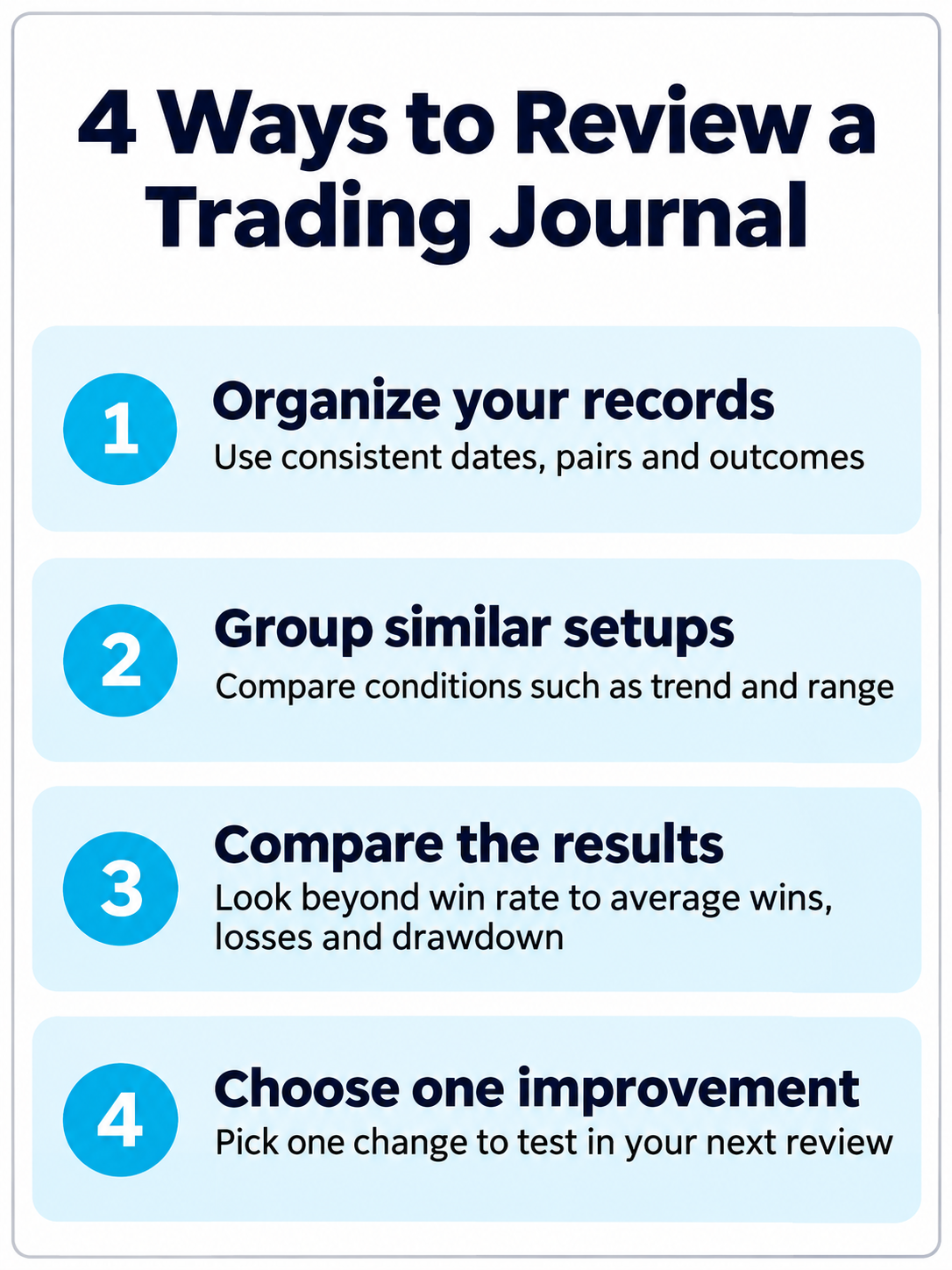
1. Organize the records
First, fill gaps and standardize labels. If you use both “stop loss” and “SL” for the same thing, it becomes harder to group the data. Use consistent formats for dates, currency pairs, direction and profit or loss.
Do not remove trades to make the results look better. Keep the decisions you actually made, including trades that did not follow your rules.
2. Group similar situations
Do not treat every trade as one group. Separate them by a condition you want to examine, such as trend versus range, long versus short, trading session, or whether you followed your rules.
If you create too many groups, each one may contain too few trades. Start with one condition you want to compare and check the number of trades before drawing conclusions.
3. Compare results using several metrics
Win rate alone does not show the whole picture. Also look at average win and loss, profit factor (PF), maximum drawdown (DD) and the number of trades.
| Metric | What to check | Keep in mind |
|---|---|---|
| Win rate | Share of profitable trades | Read with average win and loss |
| PF | Gross profit divided by gross loss | Check whether trading costs are included |
| Maximum DD | Largest drop from a balance peak | Understand both the amount and percentage |
| Average win and loss | Typical profit and loss per trade | Check whether a few trades dominate the result |
| Number of trades | Trades included in the calculation | Small samples are strongly affected by luck |
A strategy can have a low win rate and still be profitable if its average win is larger than its average loss after costs. The reverse is also possible: a high win rate can still lose overall when a single loss is large. Compare metrics over the same period and under the same conditions.
Pasting the results from your journal into our backtest results calculator gives you win rate, average result, profit factor, maximum drawdown and losing streaks in one place.
4. Choose one improvement
You may find several things to improve, but test only one at a time. Make it something you can observe, such as “do not move the stop” or “skip trades in a range”.
Test the revised rule on a different period from the one you used to adjust it. Repeatedly changing rules to fit the same data can produce a strategy that only fits that stretch of history.
Common review mistakes
Judging only by wins and losses
Calling a win “right” and a loss “wrong” confuses decision quality with luck. First check whether you followed your rules, then interpret the outcome.
Drawing conclusions from too few trades
A handful of trades can be heavily affected by market conditions and chance. If the sample is small, describe it as an early pattern rather than a firm conclusion. The more narrowly you filter the trades, the more important it is to check the count.
Explaining a losing trade after seeing what happened
Once you can see the completed chart, moves that were unknown at entry may seem obvious. Record your reasoning and stop level before or at entry, then compare the outcome with the information you had at that time.
Changing many conditions at once
When you change several things together, you cannot tell what caused the result to change. Rank the ideas and test them one by one. Backtests cannot guarantee future performance, so avoid over-fitting rules to past data.
For a closer look at a difficult sequence, our guide to reviewing forex losing streaks separates counting rules, loss amounts and rule compliance.
To preserve the conditions behind each experiment, use our backtest rule change log template and keep results separate for each version.
For candidates that produced no order, keep a separate no-trade journal for backtesting to distinguish rule-based skips from missed qualifying setups.
Make reviewing a habit
Keep each trade note short, then set a regular time—such as once a week—to review them together. Try asking:
- Did I enter and exit according to my rules?
- Which market conditions made me hesitate?
- Are my wins or losses unusually concentrated in size?
- What is one thing I can test in my next practice session?
You can also record your reasoning and rule adherence while practicing on historical charts. Repeating decisions without real money and reviewing the numbers afterward is one way to build a review habit.
Summary
To turn a trading journal into improvement, standardize the records, group similar conditions, compare several metrics, and choose one thing to test next. Record your reasoning and whether you followed your rules, rather than judging by wins and losses alone.
For your next trade, start by briefly noting why you entered and whether you followed your plan. Once you have enough records, compare trades made under similar conditions.