Journaling and review
Backtest Rule Change Log: Keep Comparisons Consistent
Published ForeXpert team日本語で読む
A backtest rule change log starts with three habits: preserve the old rules, write the proposed change and its reason before testing, and keep results separate for each version. Saving only the latest result makes it difficult to explain which change produced a difference, or even which rules you actually followed.
This guide gives discretionary forex traders a practical external-note template, a four-step comparison process, and a way to handle changes made halfway through a test. The examples illustrate recordkeeping, not a recommendation to trade a particular setup. The goal is a record you can use when planning your next test.
Why keep a backtest rule change log?
A trade journal records what you decided in an individual situation. A rule change log records which set of instructions you were testing, when it changed, and why. Connect the two with a test ID so you can trace a trade back to the rules in force at the time.
Suppose you follow rule A for the first half of a test and rule B for the second half. Saving the combined result under rule B does not tell you how B performed on its own. Deleting the older version creates a different problem: you may try the same idea again without remembering why you previously rejected it.
There is also a risk in repeatedly adjusting rules and selecting the most attractive historical results. QuantConnect's research guide cautions that repeated tests on an idea can encourage overfitting. Keeping a log does not remove that risk, but it makes the sequence of experiments visible instead of leaving only the winning version.
Use the log to preserve the question behind each experiment. “This version had the best result” is less useful than knowing what changed, which period you checked, and whether you applied the instructions consistently.
A template for recording rule changes
Keep the log in a document, notebook or spreadsheet outside the trading app. Store a complete copy of each rule version rather than only a note saying “entry changed.” A future reader, including your future self, should be able to reconstruct the instructions without relying on memory.
| Field | What to record |
|---|---|
| Rule version and test ID | A stable rule label plus a separate identifier for each test |
| Complete rules | All entry, exit and exclusion conditions, including decision timing |
| Proposed change | The single condition being revised |
| Reason and expected difference | What problem you observed and what you will check |
| Test scope and assumptions | Pair, timeframe, start and end dates, costs and execution assumptions |
| Outcome and decision | Results, unresolved questions, and accept, reject or defer with a reason |
Here is a fictional recordkeeping example. It contains no trading results and makes no claim about the effectiveness of the rule:
- Version: v2; assign a test ID before starting.
- Previous wording: condition A determines when a decision is made.
- Revised wording: evaluate the conditions only after the relevant candle closes.
- Reason: the earlier instructions allowed a mixture of decisions during a candle and after its close.
- Expected difference: decision timing should become more consistent, although the eligible trades may also change.
- Keep fixed: pair, timeframe, dates, cost treatment and all other trading conditions.
- Status: untested; fill in the outcome after completing the test.
The incomplete earlier wording is itself the issue under investigation. Before running the new version, specify exactly which observations are available at the decision time. Do not introduce additional interpretations while stepping through the chart. Our guide to look-ahead bias in backtesting explains why that information boundary matters.
Keep rule versions separate from test IDs. Testing v2 on another period creates a new test, not necessarily a new rule version. If your data or app version changes, record that separately too. Otherwise a change in the testing environment can be mistaken for the effect of a new trading condition.
Compare rule versions in four steps
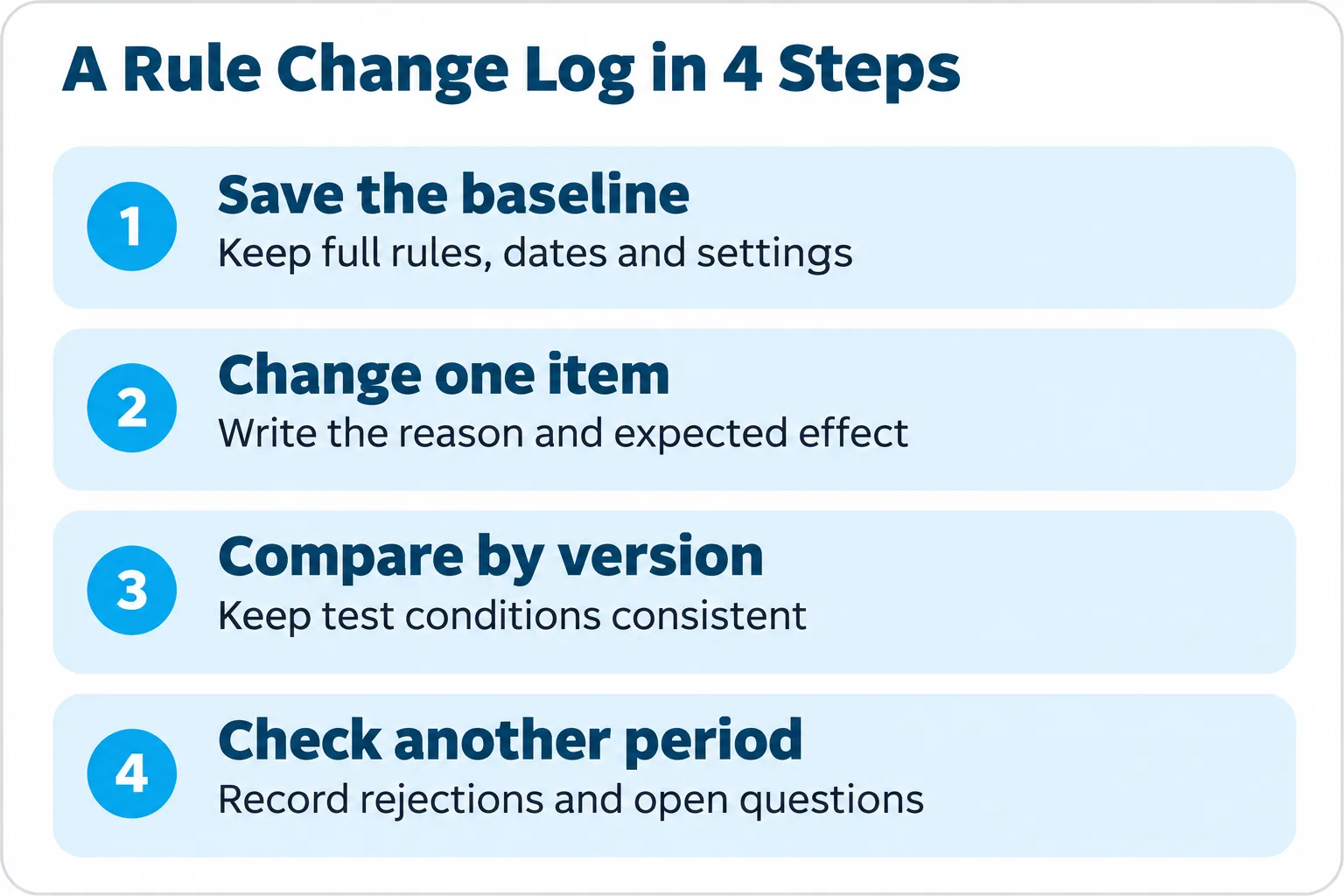
1. Save the baseline before editing
Preserve the complete existing rules, the test scope and the available results. If you have not finished the baseline test, mark it as incomplete. An unfinished run should not silently become the reference for a completed one.
Also save any explanation needed to interpret the run. A note such as “several decisions were made before the candle closed” is useful context. It does not justify rewriting those decisions after seeing the outcome.
2. Change one item and write the reason first
Describe the proposed change before viewing its results. “Improve performance” is too broad to explain what the experiment will establish. “Check whether decision timing is consistent” gives you something observable to review alongside the numbers.
If another problem appears during testing, put it on a list for a later experiment. Adding it immediately means you are no longer testing the change you originally described. Changing one item at a time helps interpretation, although chance and discretionary judgment still affect the comparison.
3. Keep the comparison assumptions consistent
Where possible, use the same pair, timeframe and dates for the baseline comparison. Matching only the number of trades while changing the historical period introduces a different market sample. Keep the period fixed and record any difference in trade count as part of the outcome.
Check that cost treatment, execution assumptions and the remaining rules are consistent. Then compare the results separately, including the number of trades and the situations where you hesitated. Do not combine the two versions into a single performance figure.
Replaying the same period has a limitation: you may remember what happens next. Label that run as a comparison on previously viewed data, rather than fresh confirmation. With discretionary rules, you also cannot assume every difference was caused solely by the edited condition. Your interpretation may have changed between runs.
4. Check another period and record the decision
If you used a period to adjust the rules, treat it as development data. Choose another, previously unseen period in advance and apply the revised instructions without further changes. Once you inspect that period and use its results to revise the rules, it is no longer untouched confirmation data.
“Defer” is a valid outcome. You may lack enough relevant situations, have inconsistent execution, or need clearer records before deciding. Preserve those reasons, as well as rejected ideas and the number of attempts. Our guide to backtesting versus forward testing explains the different stages of checking an idea.
Connect external notes to ForeXpert trade history
ForeXpert lets you practice on historical charts one candle at a time and review measures such as trade count, win rate, average win and average loss on its statistics screen. The change log described here is an external notebook or spreadsheet workflow, rather than an in-app version-management feature.
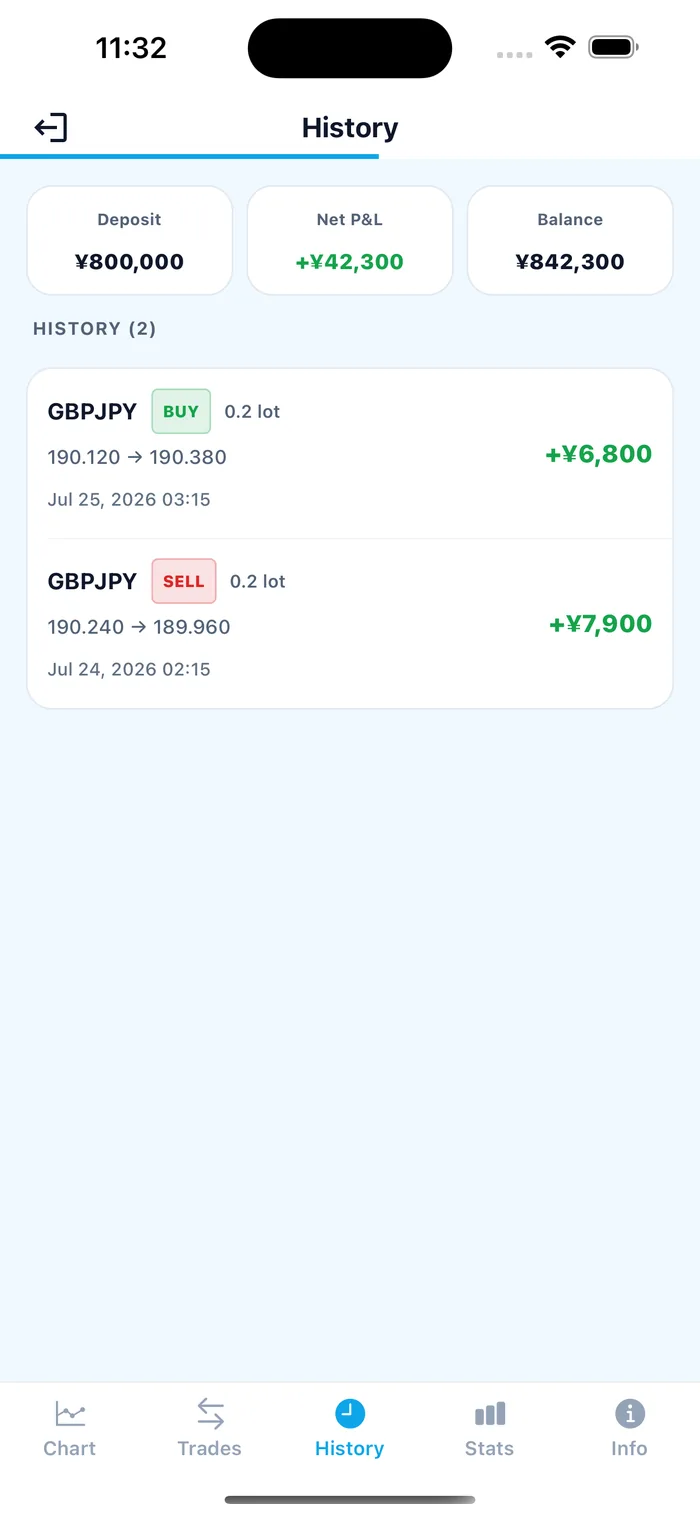
In your external notes, record the test ID and historical period. Use trade dates, direction and prices to match particular decisions to the history screen. The screenshot contains demo data; it does not show a rule-version field or evidence that any proposed change improved performance.
If you save screenshots for later review, include the test ID in their filenames. Keep the accompanying rules and assumptions in the same external record. A history image alone cannot explain why a trade was eligible or which instruction you intended to follow.
On the free plan, you can create up to three backtests per month, and the list shows the three most recent tests. Preserve the conditions and results you need for longer-term comparisons while they are available. Every currency pair, period, timeframe and the statistics screen are available on the free plan.
For reviewing the decisions behind the figures, see our guide to reviewing a trading journal. Historical backtest results do not guarantee future performance, and live forex trading carries a risk of loss.
FAQ
Must I restart if I change a rule halfway through?
You do not need to delete the record. Mark the point where the change occurred and identify the earlier segment as an incomplete run of the old version. If you want to compare full-period results, run each version over the intended period separately. Do not present the mixed run as evidence for the new version alone.
Does a wording correction need a new version?
If the correction leaves every decision unchanged, you can record it as an editorial clarification. If it changes which trades qualify or when you act, preserve it as a new rule version. The practical question is whether another person could make a different decision under the revised wording.
Should I retain rejected ideas?
Yes. Keep the reason for rejection and the period examined so you can understand a later revisit. Rejection means you did not adopt the idea under those assumptions; it is not proof that the idea could never behave differently elsewhere. Avoid rewriting that history after seeing a better result.
Summary
Save your current instructions as v1 and give each test a separate ID and period. Before the next revision, write one proposed change, its reason and what you expect to observe. Preserve the baseline and compare the versions under consistent assumptions.
Then check an unseen period without adjusting the instructions and record whether you accept, reject or defer the proposal. The useful output is not just a newer version: it is a record that explains how you reached the next testing decision.